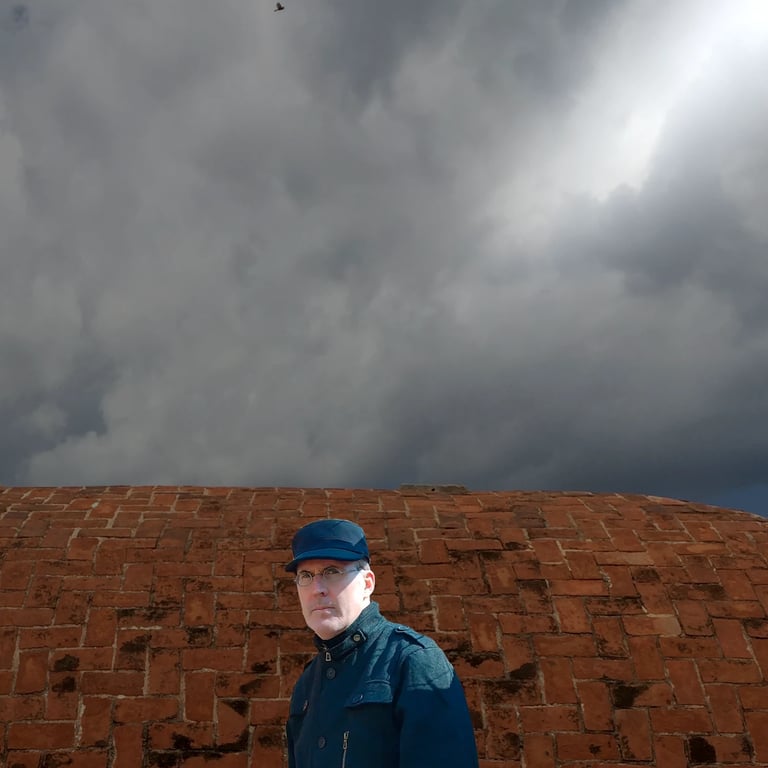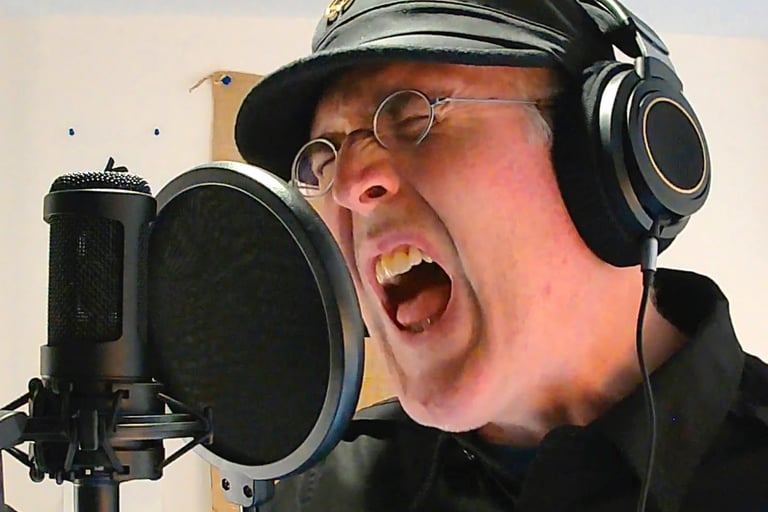
Novit Terminus / Jeremy C. Wells, Ph.D. bio
My Novit Terminus music project (2023–)
History fascinates me. I love electronic sounds. I am obsessed with psychology.
These three elements define my work as an electro-Euroatavism artist who combines ancient European musical traditions (folk and medieval) with dark, driving, electronic sounds. I use my music for psychological explorations, which relates to my project’s name, Novit Terminus. This is a Latin phrase that means “he has come to understand the limits” of something; in specific contexts, this phrase can also mean "he has become familiar with the end." (As an aside, the Latin infinitive of "novit" is "nōscere," which is similar to the Spanish infinitive "conocer" the Portuguese, "conhecer," or the Italian "conoscere." There is no direct equivalent in English.)
Music has always been a part of my life, and in the 1990s I created or co-created several music projects that received widespread distribution: Digital Black (1990-91), 68000 (1991-93), and Violet Arcana (1993-95). When I left my job as a tenured professor in 2022, a space opened that allowed me to return to making music in a more formal way, which I had long missed. At first, I used my new music project—Novit Terminus—as therapy to recover from my traumatic experiences in higher education, but it has since progressed into a fascinating exploration of ancient European musical traditions.
I refer to Novit Terminus' musical genre as “electro-Euroatavism,” which is based on medieval and European folk music traditions. Other musical artists whose work is similar to mine include Itinera, Ruiseñora, Azam Ali, Amananti, Derniere Volante, and Die Form. I’m drawn to modal structures as opposed to the nearly ubiquitous emphasis—especially in pop music—on tonality and harmony, although I still dabble in this more contemporary approach. I’m particularly intrigued by the folk music of the Iberian Peninsula, especially its percussion and rhythms. If you’re interested in more details about how I define Euroatavism and its intersection with electronic music, I’ve written an article on the topic.
To be sure, a lot of the electronic body music (EBM), like Nitzer Ebb and Front 242, that were my early musical influences, also eschewed tonality for modal compositions. There’s something primal in the drive that can come from, say, a piece in a Phrygian mode that gets lost in the world of harmony. I’m also drawn to time signatures other than 4/4; 6/8 is one of my favorites. I love the challenge, for instance, in working in 7/8, but also the off-kilter feel a song in this time signature has. Lastly, I’ve dabbled a bit in microtonality, especially Arabic maqams. Equal temperament has its place, but there’s a whole universe of feeling with other intervals.
While synthesizers (virtual and real) form the basis of my compositions, I often play percussion instruments such as the darbuka, frame drums, and pandeiro quadrado. I am currently in the process of learning the viola campaniça. All of the vocals are yours truly; I don’t use AI in any of my musical compositions. I have long had a soft spot for analog synthesizers, especially the ones that have always been unobtainable for me, such as a Yamaha CS-80. There’s a quality to these instruments that trigger my synesthesia—I experience certain sounds as three dimensional objects often accompanied by color.
More than anything, my focus on traditional European music is a kind of return to the music of my ancestors, who were from northern Europe and Spain. I think of my music as simultaneously touching my ancient past and my future. Novit Terminus is my story of becoming familiar with the boundaries of what I’ve learned through often traumatic experiences; only then is it possible to explore what lies beyond.
—Jeremy C. Wells, Ph.D., Washington, DC (US)