
Violet Arcana / Jeremy C. Wells, Ph.D. bio
You can reach me at dr.jeremy.wells@gmail.com
My co-created Violet Arcana music project (1993–1997)
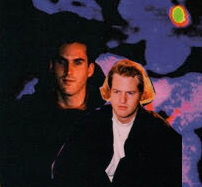
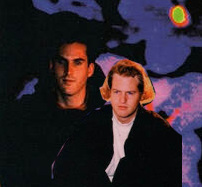
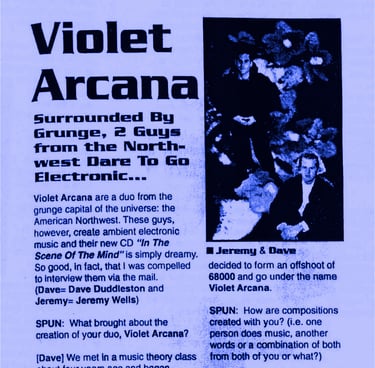
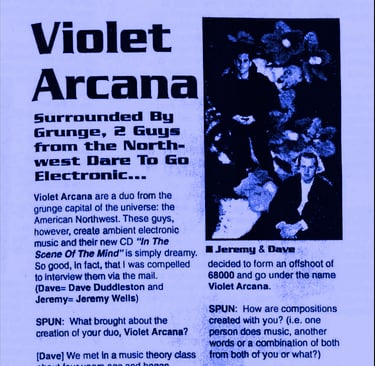
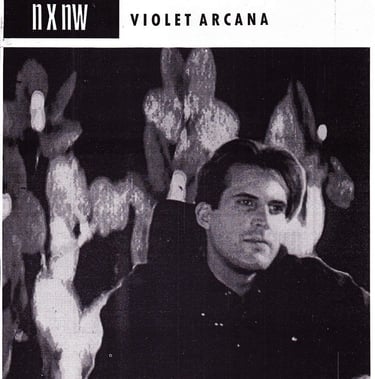
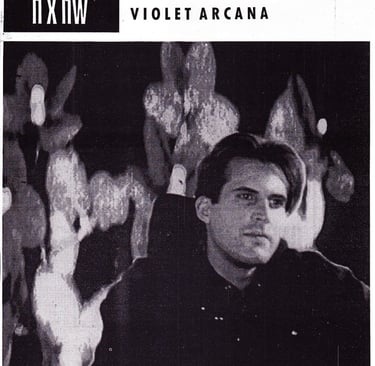
When I look back at the early 1990s in Portland, Oregon (USA), I remember a city with winters that felt like I was constantly draped in a damp, gray shroud, which became the backdrop for the birth of Violet Arcana. I had already been exploring the more rigid, mechanical boundaries of electronic music with my techno project, 68000, but there was a part of my creative spirit that felt stifled by the rigidity of the style. I wanted to create something that felt like a landscape of a contemplative and, at times, struggling mind. Violet Arcana was my attempt to combine the electronic textures I loved with a dream-like state.
I didn't embark on this journey alone. I brought in David Duddleston as a co-contributor, whose technical sensibilities and shared passion for synthesis allowed us to push the project beyond simple ambient sketches. In fact, it was David, who helped with sound design and some production work in 68000, who pointed out that my musical style was changing. When I finished the song “Disillusion” for the 50 Years of Sunshine compilation, he was pretty emphatic that what I had made “didn't sound like 68000.” When I made my next 68000 track, shortly after, for the From Here To Tranquility Volume 2 compilation, “See You in My Eyes,” even I could clearly hear something had fundamentally changed. That’s when David, who wanted a larger role in writing and composition, and I decided that we should really start a new project. The owner of Silent Records (68000’s label), Kim Cascone, was supportive and understanding of our desire to use these two 68000 tracks for the basis of our new Violet Arcana project, and contractually allowed us to re-release these songs (under new titles) as Violet Arcana works.
David and I had a shared studio in Portland where we experimented with blending trance, ambient, and what would be called, today, darkwave elements. We started working with the same electronic gear that I was using in 68000, but with our new Mac LC II, I started using early software synthesis to create the kind of mysterious, contemplative textures that I was imagining. Although in today’s world with real-time DAW plug-ins, this sounds simple, in 1994 it was not. Using a program like Lemur, you had to slowly load in a sound from a sampler (an E-mu Emax II, in my case) over a serial cable. Every edit I made to the sound in Lemur took many minutes (sometimes a half hour or more) to render before I could even hear the results. Then, after many hours of tweaking the sound in Lemur, I had to use the same serial cable process to load the sound back into the sampler. I often didn’t really know what the audio I created actually sounded like until I loaded it into the Emax because the Mac was only capable of low-fi, 8-bit output. The sound of Violet Arcana thus became this highly technical realm of convolution synthesis combined with the warm, unstable oscillators of analog synths. In particular, I really loved the sound of the ring modulator in the Rhodes Chroma Polaris, which you can hear all over Violet Arcana tracks.
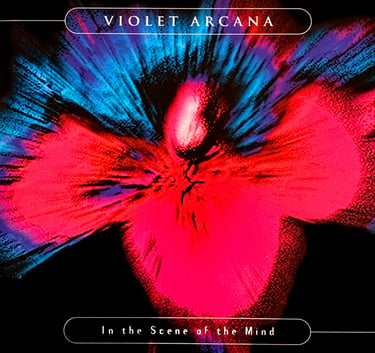
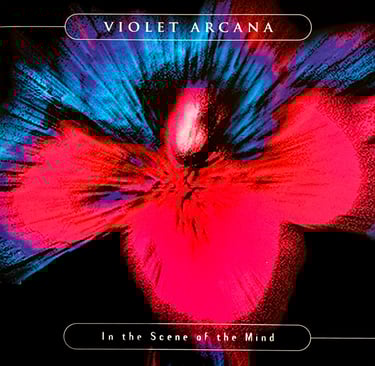
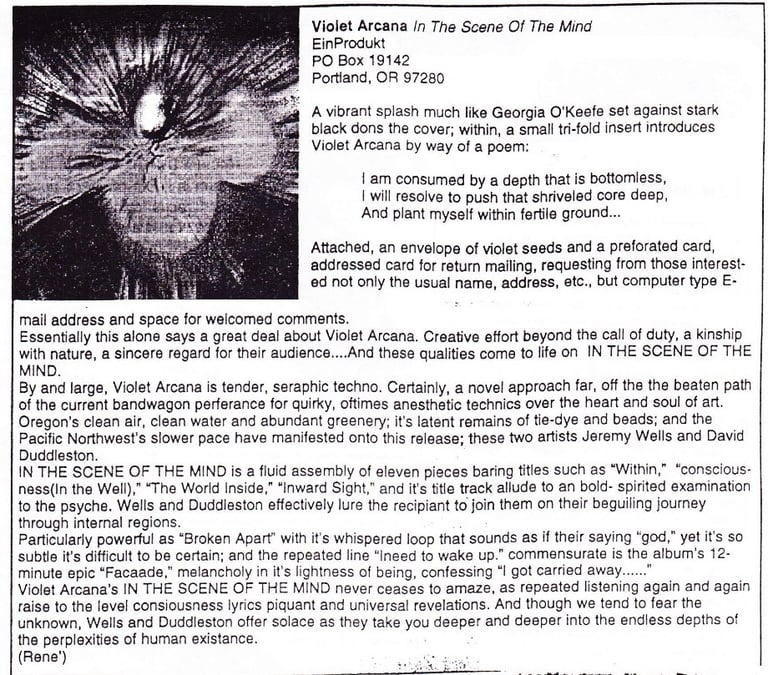
In 1994, we self-released our debut album, In the Scene of the Mind, on our EinProdukt label, which caught the attention of Talla 2XLC from Music Research/Zoth Ommog in Germany. He was impressed enough with what we were doing that he offered to release In the Scene of the Mind in all areas of the world except the United States and work with us on distributing and promoting future releases. (We retained distribution rights in the U.S.) In addition to In the Scene of the Mind, Zoth Ommog released our EP, Serenity, later that year, which featured some new Violet Arcana tracks and remixes by Zip Campisi (Thomas Franzmann) from BiGod 20. Through 1994 and ’95, Zoth Ommog also released some of our tracks that we remixed on various compilations, including Electrocity Vol.6 (Ausfahrt) where a remix of “The World Inside” sat next to tracks from Tangerine Dream, Laibach, and Love is Colder than Death.
When In the Scene of the Mind arrived in 1994, critics largely viewed it as a sophisticated departure from the aggressive industrial sounds common at the time, often describing the experience as a “futuristic, surreal, and meditative” journey. Many writers found it difficult to classify the album within a single genre, ultimately settling on a blend of ambient, trance, and dub that felt more like a “personal wonderland” than the standard EDM album. The music was praised for being exceptionally cohesive for a debut, with several reviews noting that while the programming was technically precise—drawing favorable comparisons to the structural mastery of Clock DVA—the results remained vibrant and emotionally alive.
The way I handled vocals became a specific point of interest for the music press and fans. Critics noted that my vocals (complemented by David’s on some tracks, as well) were wisely processed and kept low in the mix, functioning as a textural instrument rather than a traditional pop focal point. This allowed the album to appeal to listeners who typically found vocals in electronic music distracting, as the lyrics blended into the hypnotic, atmospheric layers of the synthesizers. While the album was rooted in the electronic world, its mellow and contemplative nature led many to describe it as a bridge between high-energy trance and the more cerebral ambient scenes of the era.
By 1995, however, I was struggling with my career—the part of my life that actually paid the bills—and I ended up moving to Richland, Washington for work as a computer systems administrator, later going back to school to study historic preservation and eventually became a tenured professor. My last Violet Arcana track was “Liquid Bleeding,” included on the enormously influential RAS DVA compilation, There Is No Time. I would not return to making music until 2023 with my electro-Euroatavism project, Novit Terminus.
David continued, however, with Violet Arcana until 1997, when he released Sonic Aquarium, which contained some unreleased Violet Arcana tracks, remixes that had been released on compilations, and some new Violet Arcana tracks solely authored by him. His Violet Arcana track, “Solace,” found on this EP, was included in the Undercurrent compilation that year, as well.
In response to significant interest in re-releasing Violet Arcana, especially on streaming services, (“Solace” is the only Violet Arcana track on Spotify, for instance), I have remastered In the Scene of the Mind and it will be available on all the major streaming services at the end of January 2026. (The remastered album is available now on Bandcamp.)
—Jeremy C. Wells, Ph.D., Washington, DC (US)
Discography
In the Scene of the Mind on EinProdukt (US), Zoth Ommog (rest of world) (1994); Remastered version on Timbre Thirst Music (2026):
Within
In The Scene of The Mind
Looking for Salvation
Consciousness (In The Well) [originally released as the 68000 track, “Disillusion”]
The World Inside
Life Has No Color
A Cause of This
Broken Apart
Inward Sight [originally released as the 68000 track, “See You in My Eyes”]
Two Lives
Façade
Serenity EP on Zoth Ommog (1994):
In The Scene Of The Mind (The Ritual Vibe) [Remixed by Zip Campisi]
Serenity
Two Lives (Wooden Voodoo Club Mix) [Remixed by Zip Campisi]
Sensory
Two Lives (Hot Shot Dub) [Remixed by Zip Campisi]
Fluidity
Sonic Aquarium on EinProdukt (1997):
Blue Void
Sensory
Kainic
World Inside (Reality Mix)
Electrorhythm
Electrorhythm 10
Citrus [World Inside, Citrus Mix]
Imagination
Serenity
Solace
Violet Arcana tracks have also been released on the following compilation CDs:
The Colors of Zoth Ommog (Zoth Ommog, 1994), “The World Inside (Reality Mix)”
We Came to Dance – Indie Dancefloor Vol. V (Sub Terranean, 1994), “In the Scene of the Mind”
The ::CatCompilation:: (Control-Alt-Delete, 1994), “In the Scene of the Mind”
Electrocity Vol. 6 (Ausfahrt, 1995), “The World Inside [Citrus Mix]”
There is No Time (RAS DVA, 1995), “Liquid Bleeding”
Minimal Synth Ethics 4 (Cri Du Chat, 1996), “Clusion”
Dark Techno – One (Quantum Loop, 1997). “Sensory”
Undercurrent (Doppler Effect, 1997), “Solace”